Raskolnikov’s first visit to Alyona Ivanovna
Crime and PunishmentRaskolnikov’s first visit to Alyona Ivanovna is a reconnaissance disguised as a pawn transaction: he enters her flat to test a plan he has begun to treat as an undertaking, while trying to suppress his own fear and disgust. The visit yields practical observations about the building, the rooms, and the old woman’s keys, but it ends not in assurance or action but in a recoil so strong that he cannot explain it away.
Approach as Rehearsal
Raskolnikov knows the walk from the gate of his lodging house exactly: seven hundred and thirty steps, counted earlier when his idea still belonged to a realm of dreams. A month later, he is on the same route for what he understands as a rehearsal, though he has not fully admitted to himself how seriously he now regards the plan. The counted distance makes his approach feel measured and deliberate; his growing excitement and nervousness make clear that the imagined act has acquired a hold on him.
Even his clothing becomes part of the calculation. He worries that his hat is too conspicuous and that people might remember it, turning an apparently trivial detail into a possible clue. The concern shows him trying to imagine the plan from the perspective of witnesses and consequences. Yet this attention to practical concealment sits beside his uncertainty: as he reaches the fourth floor, he asks himself how much more frightened he would be if he were really going to do it.
The building offers both exposure and cover. It is a large house divided into tiny tenements, inhabited by working people and marked by continual movement through its gates and courtyards. Raskolnikov is relieved not to meet any of the several door-keepers. He slips in through the right-hand entrance and climbs a dark, narrow back staircase whose turns he already knows. The setting is busy enough to make unnoticed passage possible, while its darkness seems to him to protect him from inquisitive eyes.
At the fourth floor, porters are moving furniture out of a flat formerly occupied by a German civil-service clerk and his family. Raskolnikov thinks it fortunate that the flat will soon be empty except for Alyona Ivanovna’s. This detail sharpens the visit’s character as reconnaissance: he is registering who may be nearby and how the building’s changing occupancy might affect his imagined undertaking.
Inside the Flat
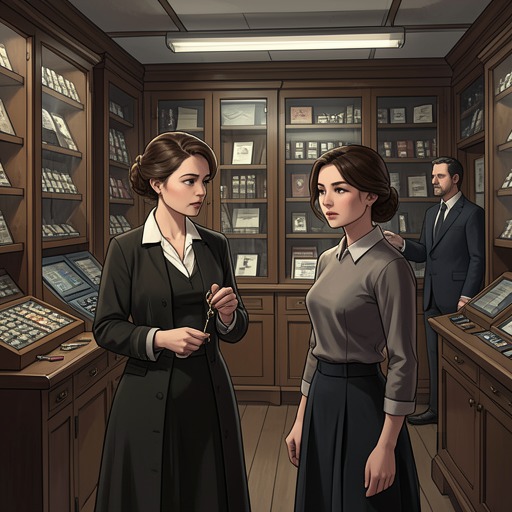
The bell gives a faint, tinny tinkle. Raskolnikov had forgotten its sound, and hearing it again seems to bring the place sharply back to him; by then his nerves are already badly strained. Alyona admits him to a small, bright room, where the setting sun falls across yellow paper, geraniums, and muslin curtains. The light prompts him to imagine that the sun will shine the same way at another visit. He scans the arrangement as quickly as he can, trying to remember it.
The room is plain but carefully ordered. Its old yellow-wood furniture includes a sofa with a large bent back, an oval table, a dressing-table with a fixed mirror between the windows, chairs, and a few inexpensive prints. A small ikon stands in the corner, and the floor and furniture are clean and polished. Raskolnikov also notices the cotton curtain leading to the second and smaller room, containing a bed and chest of drawers. The flat consists of these two rooms. His attention moves between the ordinary domestic details and their usefulness as things to remember; even the cleanliness becomes an object of wary interpretation.
He has brought an old-fashioned flat silver watch, its back engraved with a globe and its chain made of steel. Alyona tells him that the month for his previous pledge expired two days earlier. He says he will bring the interest for another month, but she returns the watch. He is angry and nearly leaves, then restrains himself because he has nowhere else to go and another purpose in coming. He tells her to take it, and the pawn transaction proceeds.
Watching and Questioning
When Alyona goes behind the curtain to unlock a chest of drawers, Raskolnikov listens and studies what he can infer from the sounds and her movements. He thinks she has opened the top drawer and notes that her keys were in her right pocket, on a steel ring. One key is much larger than the others, with deep notches. He concludes that it probably belongs not to the chest of drawers but to another chest or a strong-box. The thought is an inference, not knowledge of what the key opens; its importance lies in how carefully he turns a routine exchange into observation.
Before leaving, he says he may bring a silver cigarette-box in a day or two, once he gets it back from a friend. Then, as casually as he can manage, he asks whether Alyona is always at home alone and whether her sister is there. Alyona challenges him over why he wants to know. He brushes off the question and says goodbye. The inquiry is brief, but it exposes the second purpose of his visit: alongside testing the pawn arrangement and memorizing the rooms, he is probing the household’s circumstances.
Retreat and Significance
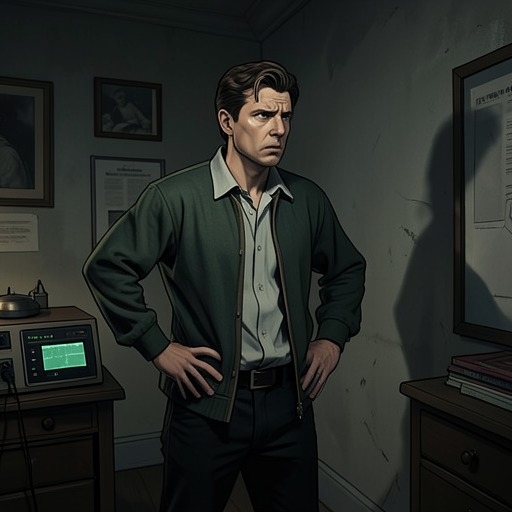
Raskolnikov leaves confused, stopping on the stairs two or three times as if struck by a thought. Outside, he calls the idea loathsome and insists that it is nonsense, while acknowledging that it has occupied him for a month. His disgust is not a settled decision to abandon the plan: the visit itself has been a rehearsal, and he has gathered observations with care. But neither has the reconnaissance made the idea emotionally manageable. The practical mind that counts steps, notices the hat, inventories the rooms, and studies the keys remains in direct conflict with his repulsion.
The scene’s force comes from that mismatch. A pawned watch and a faint bell belong to everyday life; under Raskolnikov’s attention, they become instruments in a possible crime. The visit makes his imagined plan concrete without carrying it out: he enters, looks, listens, asks, and leaves. Its outcome is therefore double. He has learned details he wanted to know, but his departure is marked by agitation and revulsion, not by a resolution that would settle the struggle.